Recognize that no specific Canadian statutory employment leave exists exclusively for inherited property sales, requiring employers to evaluate requests through existing leave frameworks. When employees inherit property requiring expedited sale—whether through estate settlement deadlines, carrying costs, or market conditions necessitating an inherited property buyer—employers must assess which leave provisions apply under provincial employment standards and workplace policies.
Evaluate bereavement leave provisions first, as inherited property situations …
Canada’s online gambling sector—encompassing platforms like all bitcoin slots on this page and other digital betting operations—presents unique employment law challenges that demand specialized compliance strategies. Employers must navigate provincial gaming regulations alongside federal employment standards, ensuring hiring practices satisfy both licensing authorities and labour law requirements. Key considerations include properly classifying workers in this gig-heavy industry, implementing robust responsible gaming policies that protect both customers and employees, and …
Establish clear written policies distinguishing vaping from traditional smoking before employees purchase vape juice online and bring devices to your premises. Canadian workplaces face evolving regulatory landscapes as provincial legislation increasingly treats vaping similarly to smoking, yet significant gaps remain in enforcement and employee awareness.
Designate specific vaping areas that comply with provincial smoke-free legislation while addressing unique concerns like secondhand vapour exposure and the discreet nature of modern vaping devices. Unlike traditional cigarettes, e-…
Distinguish between live resin vape for sale and THC products immediately—this legal distinction forms the foundation of compliant cannabis workplace policies in Canada. THCa (tetrahydrocannabinolic acid) exists in its non-psychoactive form until heated, creating unique regulatory challenges that current workplace policies may not adequately address.
Establish clear written policies that specifically name THCa products alongside traditional cannabis forms, as generic “…
The 2020 HR Tech Summit Toronto is about the technology advancement that affects today’s organizations and how the HR leaders will deal and utilize it for the future.
The event gathers over 1,000 HR and technology professionals across different industries in order to access the latest insights and successful strategies required to adapt to changes in the present and the future.
According to the annual competition run by Mediacorp Canada, the top employers of the National Capital Region include Statistics Canada, Shopify and NAV Canada.
Employment trends are shifts and patterns in workforce metrics over time, including hiring rates, turnover, job creation, wage movements, and changes in employment types or demographics. These trends reveal how labour markets evolve and signal emerging challenges or opportunities for organizations navigating workforce planning.
Understanding employment trends matters because they directly influence employment stability, the ability of workers to maintain secure, consistent employment and the capacity of employers to retain a productive workforce. When you can identify whether your industry is experiencing rising involuntary …
Standard employment refers to a traditional, full-time employment relationship where a worker is hired directly by an employer under an indefinite contract, typically working regular hours at the employer’s premises with access to full benefits and statutory protections. This classification forms the baseline against which all other employment arrangements are measured and carries significant legal implications, particularly when businesses change hands.
Understanding standard employment matters now more than ever as companies navigate complex ownership transitions, workforce restructuring, and compliance obligations. When a …
Gender diversity refers to the representation and inclusion of people across the full spectrum of gender identities within an organization, extending beyond the traditional binary categorization of male and female to encompass non-binary, transgender, gender-fluid, and other identities. In workplace and governance contexts, it means creating environments where individuals of all gender identities have equal access to opportunities, fair treatment, and the ability to participate fully in organizational life without facing discrimination or barriers based on gender.
For HR professionals and business leaders in 2026, understanding …
HR analytics in training and development transforms workforce learning from a cost center into a measurable driver of business performance by applying data science to predict skill gaps, quantify training ROI, and optimize development pathways. Organizations now rely on metrics such as time-to-competency, post-training performance lift, and retention rates of trained employees to make evidence-based decisions about where to invest learning budgets and how to design programs that deliver tangible results.
The shift reflects a broader recognition that strategic training decisions require more than instinct or industry benchmarks. HR professionals who build analytics capabilities can identify which programs close performance gaps, which delivery methods generate the strongest learner outcomes, and which cohorts benefit most from targeted interventions. This data-driven approach reduces wasted spend, aligns development initiatives with organizational objectives, and demonstrates the value of learning functions to executive leadership.
For HR teams ready to implement analytics in their training operations, success depends on three foundational elements: clean, integrated data from learning management systems and performance platforms; professionals trained in both HR practice and analytical methods; and a culture willing to test assumptions against evidence. The CHRA™ certification program, for example, equips practitioners with advanced analytical skills through real-life case studies and instruction on applying data-driven insights to talent management strategies, while emphasizing ethical considerations such as fairness, transparency, and compliance with regulatory requirements.
Whether you’re exploring the concept for the first time or preparing to build an analytics function within your organization, understanding the full lifecycle is critical. That includes knowing what HR analytics actually measures in training contexts, identifying organizational and professional prerequisites for deployment, mastering the implementation process and tools, recognizing where analytics delivers the highest impact, and navigating the ethical and legal obligations that govern workforce data use. The guidance that follows addresses each stage, offering both foundational knowledge and practical direction for applying analytics to elevate training outcomes.
Key Takeaway: HR analytics in training turns employee and learning data into evidence-based decisions about skill development, enabling organizations to identify gaps, measure learning ROI, and align training investments with business outcomes rather than guessing what works.
What HR Analytics in Training and Development Is
HR analytics in training and development is the systematic process of collecting, measuring, and analyzing workforce data to drive smarter decisions about employee learning, skills development, and organizational capability. Rather than relying on gut feel or anecdotal evidence, HR analytics transforms raw employee and HR process data into actionable insights that reveal which training investments deliver results, where skill gaps threaten business objectives, and how learning programs affect retention, performance, and productivity. In 2026, this capability has become a strategic imperative as organizations face rapid technological change, tightening talent markets, and pressure to demonstrate training ROI.
The evolution from basic reporting to strategic analytics marks a fundamental shift in how HR approaches training and development. Traditional training metrics offered only descriptive snapshots, such as how many employees completed a course or average satisfaction scores. These backward-looking numbers told you what happened but provided little guidance on what to do next. Modern HR analytics moves beyond description into predictive and prescriptive HR capabilities that forecast future skill needs, identify which employees will benefit most from specific development programs, and recommend training interventions that close performance gaps before they escalate.
Predictive analytics uses historical patterns and statistical models to anticipate outcomes. A predictive model might analyze performance data, engagement scores, and past training participation to forecast which employees face the highest risk of skills obsolescence or which teams will struggle with an upcoming technology rollout. Prescriptive analytics takes the next step by recommending specific actions. It might suggest personalized learning paths tailored to individual career trajectories, optimal timing for leadership development programs, or budget reallocations toward training interventions with the highest projected impact.
This transformation allows organizations to use workforce data strategically to improve hiring, retention, compliance, and productivity by turning employee and HR process data into action. Training decisions shift from reactive spending to proactive investments guided by data showing where development delivers measurable business value.
Who Should Build HR Analytics Capability in Training
A training team collaborates with workforce data tools to improve learning decisions and outcomes.
Organizational Readiness
Before organizations can extract meaningful insights from training analytics, they must establish the right foundations. Building HR analytics capability in training and development isn’t simply about purchasing software, it requires deliberate infrastructure, leadership alignment, and a cultural shift toward data-informed decision-making.
First, organizations need robust data collection systems that capture training metrics consistently and accurately. This means integrating learning management systems (LMS) with HRIS platforms and ensuring data flows between performance management tools, skills assessments, and business outcome metrics. Many organizations find value in specialized ERP analyst roles to bridge technical systems and ensure clean, accessible data feeds that support training analytics.
Stakeholder buy-in from senior leadership is equally critical. Executives must understand how training analytics translates into measurable business impact, reduced time-to-competency, higher retention rates, or improved productivity, and commit resources accordingly. Without this support, analytics initiatives stall when they require investment in new tools or dedicated personnel.
The organization also needs a defined training metrics infrastructure: standardized KPIs, clear data governance policies, and processes for collecting pre- and post-training performance data. This infrastructure ensures consistent measurement across departments and programs.
Finally, readiness depends on fostering a data-driven culture where HR and L&D teams view metrics as decision-making tools rather than compliance exercises. This means training staff to interpret analytics, encouraging experimentation with data insights, and rewarding evidence-based program adjustments over intuition alone.
Professional Requirements for Analytics Training
HR professionals from several disciplines stand to gain substantially from formal analytics education. Learning and development specialists who design and deliver training programs can use analytics to tailor content, predict skill gaps, and demonstrate ROI to leadership. Talent managers responsible for succession planning and career development benefit from data-driven insights that identify high-potential employees and match them with targeted development opportunities. HR business partners and generalists who advise on workforce strategy gain credibility and precision when they can support recommendations with evidence drawn from training data. Even HR leaders without direct analytics responsibilities find that foundational knowledge helps them ask better questions, interpret dashboards, and champion data-driven culture across their teams.
Advanced programs like CHRA™ typically expect participants to enter with baseline competencies. You should be comfortable working with spreadsheets, interpreting common HR metrics such as turnover rates and time-to-fill, and understanding how training outcomes connect to business performance. Strong critical thinking and problem-solving skills matter more than technical prowess; the ability to frame the right questions, spot patterns in data, and translate findings into actionable strategy forms the foundation for analytics work. Familiarity with your organization’s HRIS or learning management system is helpful, as is a willingness to engage with statistical concepts and analytical frameworks. Programs designed for HR professionals typically assume no prior programming or advanced mathematics, focusing instead on applied skills you can deploy immediately in talent management contexts.
How to Implement HR Analytics in Your Training Program
A training professional reviews analytics on a tablet to guide more targeted learning investments.
Building Analytics Skills and Capabilities
Acquiring analytics capability demands structured learning that combines statistical fundamentals with HR domain expertise. Self-study alone rarely builds the breadth needed to translate raw workforce data into strategic training decisions. Formal programs bridge technical skills, practical application, and ethical frameworks that HR professionals need to apply analytics responsibly and effectively.
Professional certification programs offer the most comprehensive pathway. The CHRA™ (Certified Human Resources Analyst) program equips HR professionals with advanced analytical skills through a curriculum that balances quantitative methods with real-life case studies drawn from talent management scenarios. Participants learn to apply predictive modeling, identify skill gaps using data, and measure training ROI while navigating ethical considerations around fairness and compliance. Engaging lectures cover statistical techniques alongside practical implementation challenges HR teams face when deploying analytics in training environments.
Dedicated HR analytics courses provide foundational skills for practitioners new to data-driven decision-making. These programs typically cover data collection methods, metric selection, visualization techniques, and interpreting results within HR contexts. Look for courses that emphasize hands-on application rather than pure theory, ensuring you can immediately apply what you learn to training effectiveness analysis or workforce planning.
When selecting a program, consider your current skill level and organizational needs. Those without statistical background benefit from courses covering analytics fundamentals before pursuing advanced certifications. Experienced analysts may choose HR analytics certification programs that focus on strategic application and emerging techniques like predictive workforce modeling. Match the program’s depth to your role: generalists need broad analytics literacy, while dedicated L&D analysts require deeper technical capabilities in measuring learning outcomes and optimizing development investments.
Essential Data, Metrics, and Tools
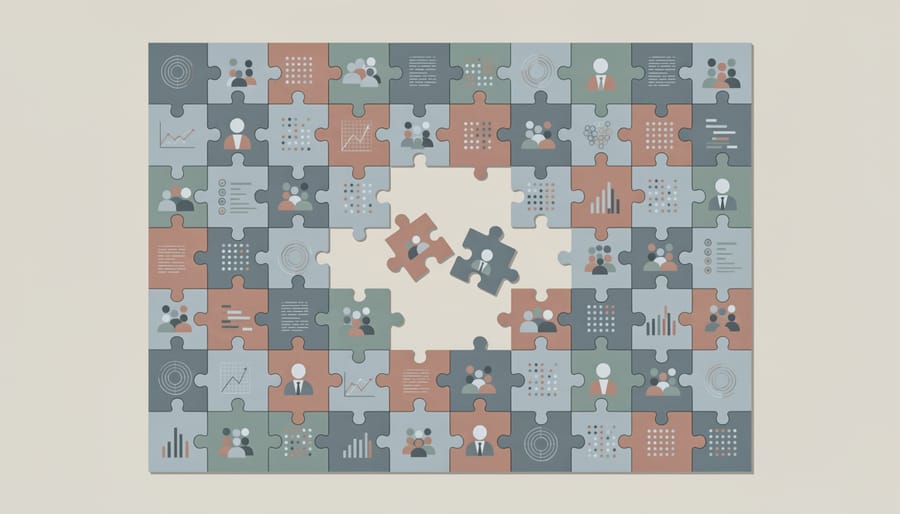
A completed puzzle symbolizes how diverse workforce and training data can come together into a clear capability picture.
Effective training analytics rests on three pillars: collecting the right data, measuring what matters, and using tools that transform raw information into actionable insights. Organizations need structured data infrastructure before they can leverage analytics to improve learning outcomes.
Start by capturing training completion rates, which track how many employees finish required or elective programs within expected timeframes. Pair this with performance improvement data that links training participation to measurable changes in job performance, productivity metrics, or error reduction. Skill assessments before and after training reveal competency gains, while engagement scores from learner feedback and participation patterns indicate whether programs resonate with employees. Most importantly, connect training data to business outcomes such as revenue growth, customer satisfaction improvements, or safety incident reductions to demonstrate real organizational impact.
Metric
What It Measures
Typical Data Source
Training ROI
Financial return versus program costs
LMS, payroll, performance systems
Time-to-Competency
Speed at which new skills reach proficiency
Skills assessments, manager evaluations
Skill Gap Closure
Reduction in competency deficits
Skills matrices, 360 reviews
Retention Impact
Training correlation with employee turnover
HRIS, exit interviews, tenure data
Training ROI stands as the ultimate accountability metric, comparing program costs against tangible benefits like productivity gains or reduced hiring expenses. Calculate it by dividing net training benefits by total program costs, then multiplying by 100 for a percentage. Time-to-competency measures how quickly employees reach full productivity after training, crucial for onboarding and upskilling initiatives. Skill gap closure quantifies the reduction in competency deficits across teams or the organization, while retention impact reveals whether development opportunities keep high performers engaged.
Modern analytics relies on integrated technology platforms. Learning management systems (LMS) serve as the foundation, capturing course completions, assessment scores, and learner engagement. HR information systems provide employee demographics, job roles, performance ratings, and tenure data that contextualize training participation. Dedicated HR analytics platforms like Visier, Tableau, or Power BI pull data from multiple sources to create dashboards, predictive models, and trend analyses. Specialized talent analytics tools such as Degreed, EdCast, or Cornerstone offer skills tracking and personalized learning recommendations based on employee profiles and career paths.
Choose tools that integrate seamlessly with your existing systems, offer user-friendly visualization capabilities, and scale with your organization’s analytics maturity. The best platform is one your team will actually use to inform training decisions, not the one with the most features.
Use Cases That Deliver Business Impact
HR analytics transforms training and development from a cost center into a strategic function that drives measurable business outcomes. When applied thoughtfully, analytics reveals patterns and opportunities that intuition alone cannot detect, enabling organizations to allocate resources where they will generate the greatest return.
Predicting skill gaps before they impact performance represents one of the most valuable applications. By analyzing workforce demographics, succession planning data, and emerging business priorities, organizations can identify which competencies will be in short supply six to twelve months ahead. A manufacturing company might discover that upcoming retirements will create a critical shortage of quality assurance expertise, allowing time to develop internal talent or adjust hiring plans before production suffers.
Personalization of learning paths has moved from aspiration to reality through analytics. Rather than enrolling everyone in the same standard curriculum, organizations now use performance data, career progression patterns, and skill assessments to tailor development programs to individual needs. High performers in sales roles might receive advanced negotiation training while those struggling with specific metrics get targeted coaching, optimizing both engagement and outcomes.
Analytics also identifies high-potential employees who warrant accelerated development investment. By correlating training completion rates, performance trajectory, engagement scores, and assessment results, organizations pinpoint individuals who combine capability with growth mindset. This data-driven approach reduces bias in talent decisions and ensures development budgets reach those most likely to fill future leadership roles.
Training effectiveness measurement that connects learning interventions to specific performance improvements and business metrics
Budget optimization by identifying which programs deliver the strongest ROI and which represent wasted investment
Retention improvement through targeted development that addresses the specific skill and career growth needs of flight-risk employees
Compliance risk reduction by tracking completion rates for mandatory training and predicting which employees are likely to fall behind
Time-to-competency acceleration by analyzing which learning formats and sequences bring new hires to full productivity fastest
The common thread across these applications is specificity. Analytics replaces guesswork about what training is needed, who should receive it, and whether it works with concrete evidence. Organizations that master these use cases report not only cost savings but stronger alignment between employee capabilities and strategic business objectives.
Responsibilities and Ethical Obligations
A padlock on storage drives represents privacy and ethical stewardship when using HR analytics for training.
Organizations implementing HR analytics in training and development carry significant responsibilities that extend beyond technical capability. As analytics becomes integral to workforce decisions, the obligation to protect employee rights, ensure fairness, and maintain regulatory compliance sits squarely with both organizational leadership and HR professionals who design and operate these systems.
Employee privacy stands as the foundational responsibility. Training analytics inevitably collects personal data, performance scores, skill assessments, learning behaviors, career aspirations, and sometimes sensitive information about capabilities or development needs. Organizations must comply with employee data protection laws that govern how this information is collected, stored, accessed, and used. This means obtaining proper consent, limiting data collection to legitimate business purposes, securing systems against unauthorized access, and providing employees transparency about what data feeds training analytics and how it influences decisions about their development opportunities.
Warning: Algorithmic bias in training analytics can perpetuate discrimination if historical data reflects past inequities in who received development opportunities, creating legal and ethical liabilities.
Fairness and transparency requirements demand that analytics models don’t disadvantage protected groups. When algorithms identify high-potential employees for leadership training or predict who will succeed in advanced programs, they can inadvertently encode historical biases if not carefully designed and monitored. HR professionals bear the responsibility to audit analytics outputs for disparate impact, validate that selection criteria relate to legitimate job requirements, and ensure development opportunities reach diverse talent pools. The CHRA™ program specifically covers ethical considerations and potential biases in HR analytics, recognizing that technical proficiency must pair with ethical awareness.
Organizations also hold compliance obligations that intersect training analytics with broader employment law compliance. When analytics inform decisions about promotions, assignments, or career progression tied to training completion, those decisions fall under employment law scrutiny. Maintaining documentation that demonstrates fair, job-related criteria becomes essential. HR professionals implementing analytics must understand both the technical requirements and the legal framework governing their use, ensuring that data-driven insights enhance rather than compromise equitable treatment and regulatory adherence across the training function.
Where to Get Training, Certification, and Support
Building HR analytics capability requires structured education and ongoing support from recognized professional bodies and industry platforms. Several pathways exist for HR professionals ready to develop analytical skills and apply data-driven frameworks to training decisions.
The Certified Human Resources Analyst (CHRA™) certification stands as a comprehensive program equipping HR professionals with advanced analytical skills through real-life case studies and engaging lectures. This credential covers predictive analytics, ethical considerations around bias, and practical application of insights to talent management strategies, making it particularly valuable for professionals responsible for training effectiveness and workforce development.
Dedicated HR analytics courses provide foundational skills for practitioners new to quantitative analysis. These programs teach learners to harness workforce data for better hiring, retention, compliance, and productivity decisions, with modules focused specifically on measuring training ROI and identifying skill gaps through analytics.
Beyond formal certification, multiple channels support skill development and knowledge sharing:
Professional HR associations offering analytics workshops, webinars, and peer learning groups
Vendor training programs from HRIS and learning management system providers that teach platform-specific analytics capabilities
Online communities of practice where HR analytics practitioners share frameworks, dashboards, and implementation experiences
University extension programs and business school certificates in people analytics and workforce planning
Many organizations find success combining formal certification with vendor-specific training, ensuring practitioners understand both analytical principles and the tools they will use daily. Starting with a recognized credential establishes the theoretical foundation, while ongoing participation in professional communities keeps skills current as analytics methodologies and technologies evolve.
How to Apply or Complete the Process
Implementing HR analytics in training and development requires a structured approach rather than a one-size-fits-all application process. Organizations should begin by assessing current data infrastructure and identifying gaps in training metrics collection. Establish baseline measures for key performance indicators before launching analytics initiatives, ensuring you can track meaningful changes over time.
For HR professionals seeking formal analytics training, research accredited programs that align with your career goals and organizational needs. The CHRA™ program requires application through its official channels, where candidates demonstrate their professional background and readiness for advanced analytical training. Similarly, targeted HR analytics courses typically involve enrollment processes that verify baseline understanding of HR principles.
Once enrolled, commit to completing coursework that covers data collection methods, statistical analysis, visualization techniques, and ethical frameworks. Apply learnings immediately through pilot projects within your organization, starting with narrow training challenges before scaling to enterprise-wide initiatives.
Organizations should establish governance protocols for training data use, including privacy safeguards, access controls, and transparency requirements. Document your analytics methodology and create audit trails that demonstrate compliance with legal and regulatory standards. Build cross-functional teams that include HR, IT, legal, and business stakeholders to ensure analytics projects meet technical, ethical, and strategic requirements from the start.
Where to Get Official Help
When implementing HR analytics in your training and development function, you’ll need guidance from several specialized sources depending on your specific needs.
For professional certification and structured analytics training, contact the organizations offering formal HR analytics programs. The Certified Human Resources Analyst (CHRA™) program provides comprehensive training in data-driven HR decision-making, including ethical frameworks and regulatory compliance. Reach out directly through their official certification channels to discuss eligibility, curriculum details, and enrollment processes.
Your HR Information System (HRIS) or Learning Management System (LMS) vendor should be your first call for technical implementation support. Most platforms offer dedicated customer success teams, training resources, and technical documentation to help you extract, analyze, and visualize training data within their systems.
For data privacy and compliance questions specific to your jurisdiction, consult your organization’s legal counsel or data protection officer. They can clarify your obligations under applicable privacy laws when collecting and analyzing employee training data.
Professional HR associations in your region often provide analytics resources, networking opportunities, and access to practitioners experienced in training analytics. Many offer workshops, webinars, and mentorship programs focused specifically on building analytics capabilities in learning and development functions.
Common Questions About HR Analytics in Training
What is predictive HR analytics and why does it matter in 2026?
Predictive HR analytics uses historical workforce data and statistical modeling to forecast future outcomes, such as which employees are likely to leave, which training interventions will close skill gaps, or where performance bottlenecks will emerge. In 2026, it matters because organizations face rapid skill obsolescence and talent shortages, making the ability to anticipate needs and proactively develop employees a competitive necessity rather than a nice-to-have.
What data and tools do I need to get started with predictive HR analytics?
You need clean, structured data on training participation, completion rates, performance metrics, skill assessments, and business outcomes like productivity or retention. Most organizations start with their existing HRIS or LMS data, then add analytics platforms that range from Excel and Power BI for basic analysis to specialized tools like Visier, Workday Analytics, or custom dashboards that integrate multiple data sources.
How do you actually measure training ROI with analytics?
Calculate training ROI by comparing the business value gained (increased productivity, reduced errors, improved retention, faster time-to-competency) against total training costs including development, delivery, employee time, and technology. Use pre- and post-training performance data to isolate the impact of the intervention, and track metrics over time to capture delayed benefits that often appear weeks or months after completion.
What skills do HR professionals need to work with analytics in training?
Start with data literacy (understanding what data means and how to interpret it), basic statistical knowledge, and critical thinking to ask the right questions. Beyond that, you need comfort with analytics tools and visualization platforms, business acumen to connect insights to organizational goals, and communication skills to translate findings into actionable recommendations for stakeholders who may not be data-savvy.
How do you address bias in training analytics?
Regularly audit your data sources, algorithms, and decision frameworks for patterns that disadvantage specific demographic groups, whether in training access, completion predictions, or performance assessments. Build diverse teams to review analytics models, ensure transparency in how recommendations are generated, and establish clear governance around fairness, privacy, and compliance with legal requirements that protect employee rights.
These questions reflect the practical concerns HR teams face when moving from intuition-based training decisions to data-driven approaches. The answers avoid generic platitudes, grounding each response in the work of collecting data, choosing tools, and applying analytical rigor while remaining ethically responsible. Notice that measuring ROI requires isolating training impact from other variables, and addressing bias is an ongoing governance practice rather than a one-time fix. Both the CHRA™ program and dedicated HR Analytics courses cover these competencies through real-life case studies and structured learning, giving professionals the foundation to implement analytics ethically and effectively in their training functions.
HR analytics has fundamentally transformed training and development from an administrative function into a strategic driver of organizational performance. By converting workforce data into actionable insights, organizations can pinpoint skill gaps before they impact productivity, measure training return on investment with precision, and make evidence-based decisions that simultaneously reduce costs and improve employee outcomes. The shift from intuition-based training planning to data-driven strategy isn’t optional anymore, it’s essential for staying competitive in 2026.
For HR professionals ready to build this capability, formal education provides the foundation. Programs designed to develop analytical skills equip practitioners with the tools to harness data-driven insights in HR decision-making, while advanced certifications like CHRA™ offer real-life case studies and hands-on experience applying analytics to talent management challenges. But technical competence alone isn’t enough. Ethical practice must guide every analytics initiative, with attention to fairness, transparency, employee privacy, and compliance with legal requirements.
Start where you are. Assess your organization’s data infrastructure, identify high-impact use cases, and invest in building your analytical skills through structured learning. The organizations that embed analytics into their training strategy today will be the ones that develop stronger talent, operate more efficiently, and adapt faster to workforce challenges tomorrow.