Recognize that no specific Canadian statutory employment leave exists exclusively for inherited property sales, requiring employers to evaluate requests through existing leave frameworks. When employees inherit property requiring expedited sale—whether through estate settlement deadlines, carrying costs, or market conditions necessitating an inherited property buyer—employers must assess which leave provisions apply under provincial employment standards and workplace policies.
Evaluate bereavement leave provisions first, as inherited property situations …
Canada’s online gambling sector—encompassing platforms like all bitcoin slots on this page and other digital betting operations—presents unique employment law challenges that demand specialized compliance strategies. Employers must navigate provincial gaming regulations alongside federal employment standards, ensuring hiring practices satisfy both licensing authorities and labour law requirements. Key considerations include properly classifying workers in this gig-heavy industry, implementing robust responsible gaming policies that protect both customers and employees, and …
Establish clear written policies distinguishing vaping from traditional smoking before employees purchase vape juice online and bring devices to your premises. Canadian workplaces face evolving regulatory landscapes as provincial legislation increasingly treats vaping similarly to smoking, yet significant gaps remain in enforcement and employee awareness.
Designate specific vaping areas that comply with provincial smoke-free legislation while addressing unique concerns like secondhand vapour exposure and the discreet nature of modern vaping devices. Unlike traditional cigarettes, e-…
Distinguish between live resin vape for sale and THC products immediately—this legal distinction forms the foundation of compliant cannabis workplace policies in Canada. THCa (tetrahydrocannabinolic acid) exists in its non-psychoactive form until heated, creating unique regulatory challenges that current workplace policies may not adequately address.
Establish clear written policies that specifically name THCa products alongside traditional cannabis forms, as generic “…
The 2020 HR Tech Summit Toronto is about the technology advancement that affects today’s organizations and how the HR leaders will deal and utilize it for the future.
The event gathers over 1,000 HR and technology professionals across different industries in order to access the latest insights and successful strategies required to adapt to changes in the present and the future.
According to the annual competition run by Mediacorp Canada, the top employers of the National Capital Region include Statistics Canada, Shopify and NAV Canada.
Upwork remains one of the most comprehensive platforms for Canadian employers seeking freelance talent in 2026, but navigating it compliantly and effectively requires understanding both the platform’s latest AI-driven features and evolving employment classification rules. For HR professionals and business owners, the challenge isn’t just finding skilled contractors. It’s ensuring your engagement model protects your organization from misclassification risks, meets provincial and federal employment standards, and leverages Upwork’s enhanced verification tools to vet candidates properly.
The platform has …
Employment stability refers to the continuity and predictability of the employment relationship, a concept distinct from job security that focuses on organizational practices and legal frameworks rather than individual protection from termination. In practical terms, stable employment environments maintain consistent work arrangements, predictable scheduling, and minimal disruption to the employer-employee relationship, even when business conditions shift.
This distinction matters because stability can exist without ironclad job security. An organization might restructure roles or adjust terms while still preserving the employment …
A group of seven workers is small enough to look informal and large enough to carry real legal weight. In most Canadian jurisdictions, when even a handful of employees act together over wages, safety, scheduling or working conditions, their conduct can qualify as protected concerted activity, and an employer’s response to it can trigger statutory obligations. Dismissing, disciplining or reassigning that group without first understanding where the law draws its lines is one of the quickest ways to turn a workplace disagreement into a formal complaint.
The number seven isn’t a legal threshold. What matters is what the group is doing, why, and how the employer reacts. Seven workers refusing unsafe work, raising a shared pay concern, or exploring union representation may each be engaging in a distinct, legally protected process, with different rules, timelines and remedies attached. Coverage from outlets such as Labour Reporter regularly shows how small-group disputes, handled badly, escalate into costly tribunal proceedings.
This article explains why small groups matter in labour relations, the scenarios HR professionals and business owners most often encounter, and practical steps for responding in a way that protects both the business and its employees.
Why a Group of Seven Workers Can Matter More Than You Think
A small group of workers meeting together highlights how collective concerns can form quickly even in everyday workplace settings.
A group of seven employees may look too small to move the needle, but Canadian labour law doesn’t measure collective rights by headcount. It looks at what the employees are doing together and why.
Take a union organizing drive. In a ten-person shop, seven workers can easily represent a clear majority. Depending on the province, that level of support may be enough to apply for certification or even trigger automatic certification once a board is satisfied that the evidence of membership support is genuine. The employer who dismisses the effort as “just a few people” may find the labour board treating it as a fully protected exercise of statutory rights.
The same logic applies to concerted activity outside of organizing. When several employees refuse unsafe work together, or sign a joint complaint about unpaid overtime, they are acting collectively. Labour boards and arbitrators generally look at the substance of that conduct: Was it a shared response to a workplace issue? Was the employer’s reaction retaliatory? Many statutes protect employees from reprisal for participating in these activities, and a response that would draw little scrutiny against one individual can look very different when aimed at a group.
There is also an operational dimension. Losing seven workers to a refusal, a grievance process or a prolonged investigation can stall production or service in a small business far more than the same loss would in a large one. Management attention, legal costs and morale all take a hit.
Finally, small-group cases carry influence beyond their size. Decisions from boards and arbitrators are frequently cited in later disputes, regardless of how many workers were involved in the original matter. A ruling on how an employer handled a group complaint in a small workplace can shape how similar facts are analyzed elsewhere. For employers and practitioners, that means treating every collective issue, whatever its scale, as potentially significant.
Common Scenarios Involving Small Groups of Workers
Concerted Work Refusals and Unsafe Work Complaints
Safety gear and an incident folder symbolize how small-group concerns often center on health and safety and trigger formal inquiries.
When several employees stop working together, the first question is why they stopped. The answer decides whether the law treats it as a protected safety refusal or as an unlawful stoppage.
The right to refuse unsafe work lets an employee decline a task they reasonably believe puts them or a coworker in danger. Several workers can refuse at once if each holds that belief honestly, and the refusal doesn’t become a strike just because the group is a group. An illegal work stoppage, by contrast, is a collective cessation of work used as pressure over pay, scheduling or other terms, outside the lawful strike process. In practice, this means a walkout during the term of a collective agreement, or without the required vote and notice.
Intent and process are what separate the two. A safety refusal is tied to a specific hazard, and the workers usually stay available for other duties.
The general investigation process follows a predictable path. The employee reports the refusal to a supervisor, who investigates with a worker or union health and safety representative present. If the concern isn’t resolved, the matter typically moves to a government inspector, who decides whether the work can continue. You can read how a typical refuse unsafe work process unfolds, though the steps differ by province and by federal versus provincial jurisdiction. Confirm your local requirements before acting.
Union Certification and Organizing in Small Workplaces
In many Canadian workplaces, seven employees is enough to start a union drive. Certification is the formal process by which a labour relations board recognizes a union as the exclusive bargaining agent for a defined group of employees. That group is called the bargaining unit, meaning the employees who share a sufficient “community of interest,” such as similar duties, supervision and working conditions, to bargain together.
The process generally begins when employees sign membership cards or petitions showing support for a union. The union then applies to the relevant labour relations board, which confirms that the proposed unit is appropriate and that support meets the statutory threshold. Depending on the jurisdiction, the board may certify based on the cards alone or order a secret-ballot representation vote. Thresholds, timelines and procedures differ between provinces and between federal and provincial jurisdictions, so employers should confirm the rules that apply to them.
Employer conduct during this period is closely scrutinized. Unfair labour practices, including interrogating employees about union activity, threatening discipline, offering benefits to discourage organizing, or terminating someone for supporting the union, can lead to remedies ranging from reinstatement to certification without a vote in serious cases. Employers generally may share accurate information and state their views, but they must not coerce or intimidate.
In a small workplace, where managers know every employee personally, even casual remarks can be read as pressure. A practical safeguard is to brief supervisors on what they may and may not say, and to involve labour counsel as soon as an application surfaces.
Group Grievances and Arbitration
When seven employees share the same complaint under a collective agreement, the union can file a single group grievance rather than seven separate ones. This is common when the issue turns on how a clause is applied, such as scheduling, overtime calculation or seniority.
The process usually follows the steps set out in the agreement. The grievance goes through internal stages, often starting with the supervisor and moving to senior management, with a chance to settle at each one. If it isn’t resolved, the union may refer it to arbitration, where a neutral arbitrator or a three-person board hears evidence and submissions from both sides.
The arbitrator’s role is to interpret the collective agreement and decide whether it was breached. Their powers come from the agreement and the governing statute, so the scope of relief can vary by jurisdiction. Typical remedies include a declaration that the employer violated the agreement, back pay, reinstatement, restored benefits or an order to stop the offending practice.
The reach of a single award often extends past the seven named employees. Other workers in similar circumstances may rely on the reasoning, and the employer’s future conduct has to account for it. Later arbitrators also tend to find prior awards persuasive, even if they aren’t strictly binding. Employers should treat each group grievance as a potential template for the whole bargaining unit.
What Labour Reporter Case Law Tells Us About Small-Group Disputes
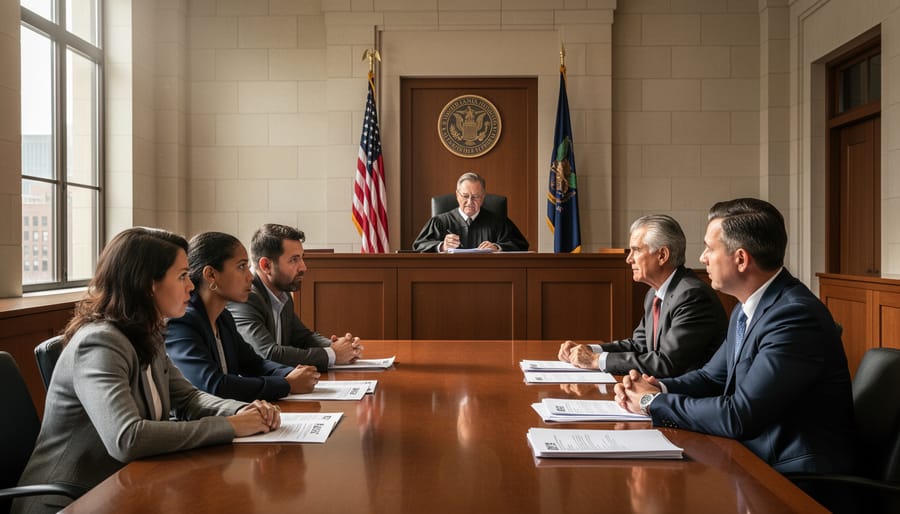
A courthouse setting reflects how disputes involving small groups can quickly move into formal labour and arbitration processes.
Tracking labour board and arbitration decisions is one of the most practical habits an HR professional or employer can build. Statutes tell you the rules. Decisions show you how those rules actually play out when a real employer and a real group of employees disagree. Labour Reporter’s coverage of these rulings makes it easier to see patterns that no single decision reveals on its own.
Several themes come up repeatedly in small-group disputes. The first is evidence of collective intent. Decision-makers look closely at whether employees acted together or just happened to raise similar concerns at the same time. Group emails, joint meetings, and shared statements to management can all shape how an action is characterized, and that characterization often determines which legal framework applies.
The second theme is employer conduct. Boards and arbitrators examine what the employer did before, during, and after the dispute. Timing matters. Discipline that follows closely on the heels of a group complaint draws scrutiny, even when the employer believes it has a legitimate, unrelated reason.
The third is procedural fairness. Did the employer investigate before acting? Were employees told what was alleged and given a chance to respond? Skipped steps can undermine an otherwise defensible position.
Experienced labour lawyers and HR leaders tend to read decisions the same way. They pay less attention to the headline outcome and more to the reasoning: which facts carried weight, which were dismissed, and what the employer could have done differently. A useful rule of thumb is to ask how your own file would look if a neutral third party reviewed it a year from now.
Because outcomes depend heavily on the specific facts and the jurisdiction, treat any decision as a guide to how reasoning works, not a prediction of how your matter will end. Confirm the applicable provincial or federal rules with legal counsel before acting.
Practical Steps for Employers Facing a Small-Group Dispute
Mistakes That Escalate Small Disputes
Reprisals are the costliest error. Disciplining or sidelining employees soon after a group complaint invites the argument that the employer acted because of the complaint, and that shifts the story from the workers’ conduct to yours. Even a legitimate decision can look retaliatory if the timing is poor.
Inconsistent messaging is nearly as damaging. When a supervisor downplays the issue, HR cites policy and an owner makes promises in the hallway, each statement can be used as evidence of confusion, bad faith or an admission. Pick one spokesperson and one script.
Failing to document conversations leaves you defending decisions from memory. Notes on who said what, and when, carry weight that recollection never will. Good HR reporting habits make this routine rather than a scramble after a dispute begins.
Finally, don’t treat the matter as an individual performance issue. Reaching for probation dismissal rules to quietly remove a few participants can backfire badly.
Building Prevention Into Your Labour Relations Approach
Most collective disputes don’t appear out of nowhere. They build from small, unresolved frustrations, which means the best protection is a steady, boring routine of good practice rather than a dramatic response once a group has formed.
Start with clear, written policies on scheduling, discipline, safety and complaints, and make sure managers apply them the same way every time. Inconsistency is one of the fastest ways to turn an individual gripe into a shared grievance. Employees who see the same rule enforced differently for different people tend to compare notes quickly.
Next, give people a safe and visible way to raise concerns. That might be a named HR contact, an anonymous reporting line or a regular open-door session. What matters is that employees believe a complaint will be heard and handled without reprisal. When concerns have no outlet, they tend to find one collectively.
Invest in manager training as well. Front-line supervisors are usually the first to hear about a problem, and they need to know how to listen, document, escalate and, just as important, what not to say or do during an organizing effort or group complaint.
Finally, keep communication open and two-directional. Explain decisions, invite feedback and follow up on what you hear.
Prevention also depends on staying informed. Statutes, board practices and arbitral thinking shift over time, so follow resources like Labour Reporter and watch broader employment trends to adjust your policies before problems surface.
Frequently Asked Questions About Small-Group Labour Issues
Readers often ask the same practical questions when a small group of employees acts together. The answers below are general; the details depend on your jurisdiction and, in unionized settings, your collective agreement.
Does a group of seven workers have the same legal protections as a larger group?
Generally, yes. Rights tied to concerted activity, health and safety, and protection from reprisal typically do not depend on headcount. Thresholds for things like certification applications and bargaining-unit eligibility do vary, so check your provincial or federal labour relations statute.
Can an employer discipline employees for raising a group complaint?
Not simply for raising it. Disciplining workers because they complained together, or for exercising statutory rights, can amount to unlawful reprisal or an unfair labour practice. Discipline for genuine, separately documented misconduct is a different matter, but timing and consistency will be closely examined.
When should an employer involve legal counsel?
Early, ideally before any discipline, termination or public statement. Counsel can help you assess whether the situation involves a work refusal, an organizing effort or a grievance, and can help you avoid missteps that increase exposure.
Should a group dispute be handled as an individual performance issue?
Usually not. Treating a collective concern as a series of individual problems can misread the legal character of the situation and invite a complaint. Look at the shared issue first, then address any individual conduct separately and on its own record.
Beyond these answers, the safest habit is to treat every collective concern as potentially significant, whatever the number of people involved. Document what you know, keep communication consistent, and confirm the rules that apply to your workplace before you act. Provincial and federal regimes differ, and a quick check up front costs far less than correcting a mistake later.
Seven workers, seventy, or seven hundred: the size of the group doesn’t decide whether a labour matter is serious. The legal questions, the procedural duties and the reputational stakes arrive the moment employees act together, and a small group can set the tone for how your whole workforce views management.
The practical takeaways are straightforward. Gather the facts before you react. Avoid anything that looks like reprisal. Document conversations and decisions as they happen. Bring in legal counsel early, and check whether a collective agreement or provincial or federal statute governs your situation. Then invest in prevention through clear policies, open complaint channels and trained managers, so that disputes surface early and stay manageable.
Labour law moves, and board and arbitration decisions keep refining how these situations are handled. Follow Labour Reporter for ongoing coverage of the rulings and developments shaping workplaces of every size, so your next decision rests on current, reliable information.