A peptide certificate of analysis (COA) from suppliers such as https://kylopeptides.ca/ is readable in about fifteen minutes if you know which five things to check: the batch number, the purity figure and the method behind it, the identity confirmation, the testing laboratory, and the date. Match those against the product in front of you, and you’ll know whether the document supports the supplier’s claims or merely decorates them.
For HR, compliance and legal teams, the COA is a due-diligence record, much like a supplier audit certificate. It should be specific, traceable and …
Recognize that no specific Canadian statutory employment leave exists exclusively for inherited property sales, requiring employers to evaluate requests through existing leave frameworks. When employees inherit property requiring expedited sale—whether through estate settlement deadlines, carrying costs, or market conditions necessitating an inherited property buyer—employers must assess which leave provisions apply under provincial employment standards and workplace policies.
Evaluate bereavement leave provisions first, as inherited property situations …
Canada’s online gambling sector—encompassing platforms like all bitcoin slots on this page and other digital betting operations—presents unique employment law challenges that demand specialized compliance strategies. Employers must navigate provincial gaming regulations alongside federal employment standards, ensuring hiring practices satisfy both licensing authorities and labour law requirements. Key considerations include properly classifying workers in this gig-heavy industry, implementing robust responsible gaming policies that protect both customers and employees, and …
Establish clear written policies distinguishing vaping from traditional smoking before employees purchase vape juice online and bring devices to your premises. Canadian workplaces face evolving regulatory landscapes as provincial legislation increasingly treats vaping similarly to smoking, yet significant gaps remain in enforcement and employee awareness.
Designate specific vaping areas that comply with provincial smoke-free legislation while addressing unique concerns like secondhand vapour exposure and the discreet nature of modern vaping devices. Unlike traditional cigarettes, e-…
Distinguish between live resin vape for sale and THC products immediately—this legal distinction forms the foundation of compliant cannabis workplace policies in Canada. THCa (tetrahydrocannabinolic acid) exists in its non-psychoactive form until heated, creating unique regulatory challenges that current workplace policies may not adequately address.
Establish clear written policies that specifically name THCa products alongside traditional cannabis forms, as generic “…
The 2020 HR Tech Summit Toronto is about the technology advancement that affects today’s organizations and how the HR leaders will deal and utilize it for the future.
The event gathers over 1,000 HR and technology professionals across different industries in order to access the latest insights and successful strategies required to adapt to changes in the present and the future.
According to the annual competition run by Mediacorp Canada, the top employers of the National Capital Region include Statistics Canada, Shopify and NAV Canada.
Upwork remains one of the most comprehensive platforms for Canadian employers seeking freelance talent in 2026, but navigating it compliantly and effectively requires understanding both the platform’s latest AI-driven features and evolving employment classification rules. For HR professionals and business owners, the challenge isn’t just finding skilled contractors. It’s ensuring your engagement model protects your organization from misclassification risks, meets provincial and federal employment standards, and leverages Upwork’s enhanced verification tools to vet candidates properly.
The platform has …
A peptide certificate of analysis (COA) from suppliers such as https://kylopeptides.ca/ is readable in about fifteen minutes if you know which five things to check: the batch number, the purity figure and the method behind it, the identity confirmation, the testing laboratory, and the date. Match those against the product in front of you, and you’ll know whether the document supports the supplier’s claims or merely decorates them.
For HR, compliance and legal teams, the COA is a due-diligence record, much like a supplier audit certificate. It should be specific, traceable and verifiable. A report that is vague, undated or detached from a batch number is a weak document, whatever the purity percentage says. Suppliers that publish COAs make this kind of review a practical, repeatable exercise.
This guide sets out what you need on hand, the red flags that should stop your review, a step-by-step reading order, and how to verify what you’ve read. It stays on document review, not medical or product claims. Plain-language definitions accompany each technical term, so you can evaluate the paperwork without a chemistry background.
Key Takeaway: A COA documents what was tested in one batch. On its own, it does not establish safety, legality or fitness for any purpose, so treat it as one piece of evidence, not a verdict.
Why Workplace and Legal Professionals Are Being Asked to Interpret a COA
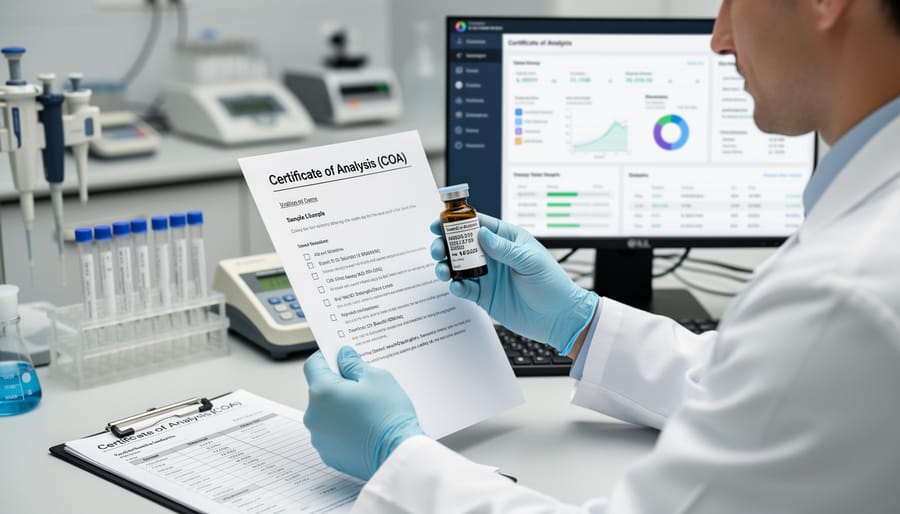
Professionals review documentation carefully before making procurement or compliance decisions. The image underscores that reading a COA is a formal, evidence-based step.
A peptide certificate of analysis rarely starts life on a scientist’s desk. More often it arrives with a supplier questionnaire, a vendor onboarding file, or a complaint that someone else has already escalated. HR and procurement teams meet it during supplier due diligence. Benefits managers see it when an employer-sponsored wellness program touches products that claim to contain specific compounds. Compliance and legal teams get it when a drug and substance policy question comes up, when a product-liability or misrepresentation claim is being assessed, or when a document is offered as evidence in an employment or regulatory matter. Reading it competently now sits alongside the broader work of building a sound compliance strategy because a poorly understood document can quietly weaken a file.
It helps to be exact about what the document is. A COA is a batch-specific quality record issued by a testing laboratory or a manufacturer. It reports what was measured in one lot, using named methods, against stated specifications.
It is not proof that a product is safe, effective or lawful to sell or use in Canada, and it is not a regulatory approval. In short, CoA is not regulatory proof. It tells you something about a batch, nothing more.
Keeping that boundary clear from the outset protects you from over-relying on a single page.
What You Need Before You Start Reading: Tools and Materials
A peptide vial symbolizes the batch-specific nature of COAs and the need to inspect the supporting documentation with care.
Gathering the Documents
Before you read a single result, collect everything that lets you test the report against reality. A COA reviewed in isolation can look convincing while telling you nothing about the product actually in front of you. Each item below gives you a point of comparison or a way to check the report independently.
The complete COA, every page, as a native PDF rather than a screenshot or cropped image.
The product label, with the batch or lot number clearly legible.
The supplier’s stated specifications, such as target purity and expected molecular weight.
The testing laboratory’s full name, address and contact details.
A prior COA for the same product, if one exists, for comparison.
A simple review checklist or template to record your findings.
A named contact who can request raw data from the supplier or lab.
The label and COA must agree on the lot number, so keep them side by side. The supplier’s specifications give you the pass/fail benchmarks. Lab contact details let you confirm the report is genuine. If any item is missing, note it in your file before proceeding, since gaps are part of the evidence.
Key Terms You Will Encounter
HPLC (high-performance liquid chromatography) is a lab technique that separates a sample into its components and measures how much of each is present. On a COA, it produces the purity percentage and a chromatogram, the graph showing each component as a peak.
Mass spectrometry measures the weight of the molecules in a sample. It is used to confirm identity, meaning the molecule found matches the one the label claims.
Purity is the share of the target peptide among all peptide-related material detected. It says nothing about water, salts or other non-peptide content.
Net peptide content is the actual proportion of the powder that is peptide. It is often noticeably lower than the purity figure.
Endotoxin refers to bacterial fragments that can contaminate a product, and reports sometimes list it as a safety-related test.
TFA (trifluoroacetic acid) is a leftover from manufacturing. Some reports state its level as a residual.
Stop Conditions and Cautions: When a COA Should Not Be Trusted
The locked folder and seal represent stop-and-escalate caution when COAs show inconsistencies or missing verification details.
Red Flags That Mean Stop and Escalate
If any of the following appears, pause the review. These problems don’t prove fraud on their own, but each one removes a reason to trust the document, and a COA you can’t trust is worse than no COA at all.
No laboratory name, address or contact details anywhere on the report.
A missing or illegible batch or lot number, so the report can’t be tied to the product.
A generic or reused template, such as identical layout and wording across unrelated products.
No signature, authorization or date, leaving no one accountable for the results.
Pixelated, misaligned or edited-looking images, especially around numbers, logos and chromatograms.
A purity percentage stated with no testing method behind it.
Identical results across different batches, which real manufacturing variation rarely produces.
A laboratory that can’t be independently contacted or verified.
Stopping doesn’t mean you must reach a verdict. It means you stop relying on the document and send it up the chain. Pass the report, the product label and your notes to legal or compliance, and record exactly which flag triggered the pause. The same discipline applies to any questionable paperwork that touches workplace compliance: document the concern, avoid improvising conclusions, and let qualified advisors decide what happens next.
How to Read a Peptide Certificate of Analysis, Step by Step
Step 1 to 3: Confirm the Lab, the Batch and the Methods
This scene conveys validation and due diligence, checking that the right sample and testing context correspond to the COA.
Start with the issuer. The report should name the laboratory, give a physical address and contact details, and show a signature or authorization. A missing lab name is a stop point, not a detail to chase later.
Next, match the lot. The batch or lot number on the COA must be identical to the one printed on the vial or label in hand. A COA for a different lot tells you nothing about your product, however polished it looks.
Then check the methods. Look for the named techniques, typically HPLC for purity and mass spectrometry for identity. A purity figure with no stated method is just a number.
Warning: A COA does not certify that a product is safe or approved for human use. If any red flag appears, stop the review and escalate it, for example to an employment lawyer or your compliance team.
An independent third-party lab generally carries more weight than a seller’s in-house report, because it has no stake in the result. That’s a reason for more confidence, not proof. Third-party reports can be forged or misread, and in-house labs can be rigorous. Treat the issuer as one signal and keep reading.
Step 4 and 5: Purity and Identity Results
Purity and identity are the two results that carry the most weight on a peptide COA, and they answer different questions.
HPLC (high-performance liquid chromatography) separates a sample into its components and draws a chromatogram, a line with peaks. Each peak is a different substance. The purity percentage is the area of the main peak divided by the total area of all peaks. A report showing 98% purity means roughly 98% of the peptide-related material detected was the target peptide. Look for a visible, sharp main peak, a stated detection wavelength, and a note of whether small impurity peaks are shown or hidden by a trimmed image.
Mass spectrometry answers a separate question: is it the right molecule? It measures molecular weight, which should match the expected value for that peptide within a small tolerance. A strong purity figure with no matching mass only proves the vial holds one consistent substance, not necessarily the one on the label.
Read the two together. In sequence, the reviewer’s task looks like this:
Locate the HPLC result and note the purity percentage and the method used.
Inspect the chromatogram for one dominant peak and clearly labelled axes.
Find the expected molecular weight in the specification.
Compare it with the mass spectrometry result, allowing only a minor difference.
Escalate any mismatch or missing spectrum before going further.
Purity without identity, or identity without purity, is an incomplete answer.
Step 6 to 9: Content, Contaminants and Sign-Off
A 99% purity figure says nothing about how much peptide is actually in the vial. Purity describes the proportion of the target peptide among peptide-related material. A vial can also hold water, counter-ions such as trifluoroacetic acid (TFA), and residual salts. This is why Step 6 is net peptide content, the percentage of the powder that is actual peptide. Credible reports state it, often well below 100%, and say how it was measured. Treat a missing figure as a question for the supplier.
Step 7 covers contaminants. Look for endotoxin results, microbial testing, residual solvents or heavy metals, each with a stated limit and a result. Report these as written, and do not read them as a safety finding. The test, the limit and the outcome should all appear.
Step 8 is comparison. Set each result against the specification the supplier published, line by line. A result that sits just under a limit, or a specification that appears only after the test, deserves a follow-up question.
Step 9 is sign-off. A proper report names an authorized signatory, carries a test date and a report date, and ties both to the batch. Unsigned or undated reports weaken the record. If this step fails, escalate rather than assume.
Verifying What You Have Read and Deciding What Comes Next
A COA is only as reliable as the document behind it, so the last step is to verify the report itself. Start with the issuing lab. Use contact details you find independently, not the ones printed on the COA, and ask them to confirm that the report exists and that the lot number, date and results match what you hold.
Here is a practical verification routine:
Contact the testing lab directly and confirm the report is genuine.
Request the raw data, meaning the HPLC chromatogram and the mass spectrum behind the summary figures.
Cross-check the lot number against the product label and the supplier’s records.
Compare results with earlier batches, since identical numbers across different lots are a warning sign.
Record the review outcome, including who did it, when, and what was found.
Once verification is complete, decide on one of four outcomes. Accept the COA if the lab confirms it and every entry is consistent. Request clarification if something is incomplete, such as a missing method or an unclear specification. Reject it if the lab cannot be reached, denies issuing the report, or the data does not match the lot. Escalate to legal or compliance if the document appears altered, if the product is being used or marketed in a way that creates liability, or if a dispute is likely.
A note on record-keeping: write down the basis for your decision at the time you make it. File the COA, your correspondence with the lab, the raw data you received and a short summary of your reasoning. If the decision is questioned months later, a dated record showing what you checked and why you reached your conclusion is far more defensible than a recollection. It also lets a colleague or counsel retrace your steps without starting over.
Common Questions About Reading a Peptide COA
Most readers finish a COA with the same handful of follow-up questions. These answers stay general and non-medical, and none of them replaces advice from a qualified professional.
What purity percentage is considered acceptable?
There is no universal threshold. Acceptability depends on the supplier’s stated specification, and the number matters only if the COA names the method behind it and the result meets the stated limit. A high figure with no method listed tells you very little.
Is a COA the same as regulatory approval?
No. A COA describes the testing of one batch. It does not show that a product is safe, effective or lawful to sell or use.
Can a seller’s own COA be trusted?
It can be accurate, but it carries less weight than a report from an independent laboratory, because the seller has an interest in the result. Verify any COA by contacting the issuing lab and requesting the raw data, whoever produced it.
What does “for research use only” mean?
It signals that the product is not intended or approved for human consumption. A COA does not change that status, so it should never be used to justify putting a product into a workplace wellness program or personal use.
How recent should a COA be?
It should be tied to the specific lot in your hands, with a clear test date. A COA that predates the batch, or one reused across several lots, is a reason to ask questions.
What should an employer or legal reviewer do if a COA looks inconsistent?
Stop relying on it, ask the supplier and the issuing lab for clarification, and escalate to legal or compliance if the answers are unsatisfactory. Keep a written record of what you asked and what you received, since documenting decisions protects the organization if the review is questioned later.
When several of these answers point the same way, such as an unverifiable lab, a missing method and an unclear batch match, treat the document as unreliable rather than trying to explain the gaps away.
Reading a peptide COA comes down to a repeatable order of checks. Start with the issuing lab, then confirm the batch number matches the product in front of you. Note the methods used, then look at purity, identity, and net peptide content as three separate questions. Finally, review any contaminant testing and confirm the report is properly signed and dated.
Keep the limits in view, though. A COA is evidence about one batch at one point in time. It is not proof that a product is safe, effective, or lawful to sell or use, and it is not a regulatory approval. A clean-looking report can still be incomplete, outdated, or wrong.
You already apply this discipline elsewhere. HR and legal teams verify signatures, dates, and sources before relying on a document, and a COA deserves the same scrutiny. Record what you checked and why you reached your decision. When something looks inconsistent, or the stakes involve health or liability, escalate to qualified legal, compliance, or scientific professionals rather than guessing.