Recognize that no specific Canadian statutory employment leave exists exclusively for inherited property sales, requiring employers to evaluate requests through existing leave frameworks. When employees inherit property requiring expedited sale—whether through estate settlement deadlines, carrying costs, or market conditions necessitating an inherited property buyer—employers must assess which leave provisions apply under provincial employment standards and workplace policies.
Evaluate bereavement leave provisions first, as inherited property situations …
Canada’s online gambling sector—encompassing platforms like all bitcoin slots on this page and other digital betting operations—presents unique employment law challenges that demand specialized compliance strategies. Employers must navigate provincial gaming regulations alongside federal employment standards, ensuring hiring practices satisfy both licensing authorities and labour law requirements. Key considerations include properly classifying workers in this gig-heavy industry, implementing robust responsible gaming policies that protect both customers and employees, and …
Establish clear written policies distinguishing vaping from traditional smoking before employees purchase vape juice online and bring devices to your premises. Canadian workplaces face evolving regulatory landscapes as provincial legislation increasingly treats vaping similarly to smoking, yet significant gaps remain in enforcement and employee awareness.
Designate specific vaping areas that comply with provincial smoke-free legislation while addressing unique concerns like secondhand vapour exposure and the discreet nature of modern vaping devices. Unlike traditional cigarettes, e-…
Distinguish between live resin vape for sale and THC products immediately—this legal distinction forms the foundation of compliant cannabis workplace policies in Canada. THCa (tetrahydrocannabinolic acid) exists in its non-psychoactive form until heated, creating unique regulatory challenges that current workplace policies may not adequately address.
Establish clear written policies that specifically name THCa products alongside traditional cannabis forms, as generic “…
The 2020 HR Tech Summit Toronto is about the technology advancement that affects today’s organizations and how the HR leaders will deal and utilize it for the future.
The event gathers over 1,000 HR and technology professionals across different industries in order to access the latest insights and successful strategies required to adapt to changes in the present and the future.
According to the annual competition run by Mediacorp Canada, the top employers of the National Capital Region include Statistics Canada, Shopify and NAV Canada.
In Canada, employers can terminate an employee during a three-month probationary period with minimal notice or pay in lieu, typically as little as one day to one week, provided the dismissal is not discriminatory or made in bad faith. This compressed notice requirement exists because probationary employees have not yet established significant tenure with the organization, and both parties retain greater flexibility to end the employment relationship if it proves unsuitable. However, this flexibility comes with strict boundaries: even during probation, employers must follow provincial employment standards legislation, avoid terminations …
A labor reporter is a journalist who covers workplace issues, union activity, employment trends, and labor relations for news organizations. These specialized reporters investigate stories about wages, working conditions, strikes, collective bargaining, and employment policy, serving as a critical bridge between workers, employers, and the public. Labor reporters typically work for newspapers, wire services, trade publications, or digital news outlets, bringing expertise in employment law, economics, and workplace dynamics to their coverage.
…
When Georgia businesses change hands through a sale or merger, employment law obligations don’t simply disappear. Under Georgia law, which follows the at-will employment doctrine and lacks many state-specific employment mandates, the structure of your transaction determines whether employment liabilities transfer to the buyer. Asset purchases typically allow buyers to cherry-pick obligations, while stock sales automatically transfer the entire employment relationship and its associated compliance history.
The stakes are significant. Buyers who fail to conduct proper employment law due diligence may inherit wage and hour …
Establish clear written policies distinguishing vaping from traditional smoking before employees purchase vape juice online and bring devices to your premises. Canadian workplaces face evolving regulatory landscapes as provincial legislation increasingly treats vaping similarly to smoking, yet significant gaps remain in enforcement and employee awareness.
Designate specific vaping areas that comply with provincial smoke-free legislation while addressing unique concerns like secondhand vapour exposure and the discreet nature of modern vaping devices. Unlike traditional cigarettes, e-cigarettes produce minimal odour and can be concealed easily, creating enforcement challenges that require proactive policy language and manager training.
Audit your current workplace policies to identify whether existing smoking restrictions explicitly include vaping products, as many older policies predate widespread e-cigarette adoption. Most provinces now regulate vaping under smoke-free acts, but employers retain responsibility for implementing workplace-specific rules that may exceed legislative minimums.
Address the accessibility factor directly in your policy documentation. The ease of online purchasing means employees can obtain vaping products discreetly and inexpensively, making education about workplace rules more critical than ever. Your policy should clarify that all vaping products fall under smoking restrictions regardless of purchase method.
Communicate policies through multiple channels including employee handbooks, onboarding materials, and posted signage. Regular reminders prove essential as vaping normalization increases and new employees join your organization. Consider consulting legal counsel to ensure your policies align with provincial human rights obligations while protecting workplace health and safety.
The Legal Landscape: Provincial and Federal Vaping Regulations
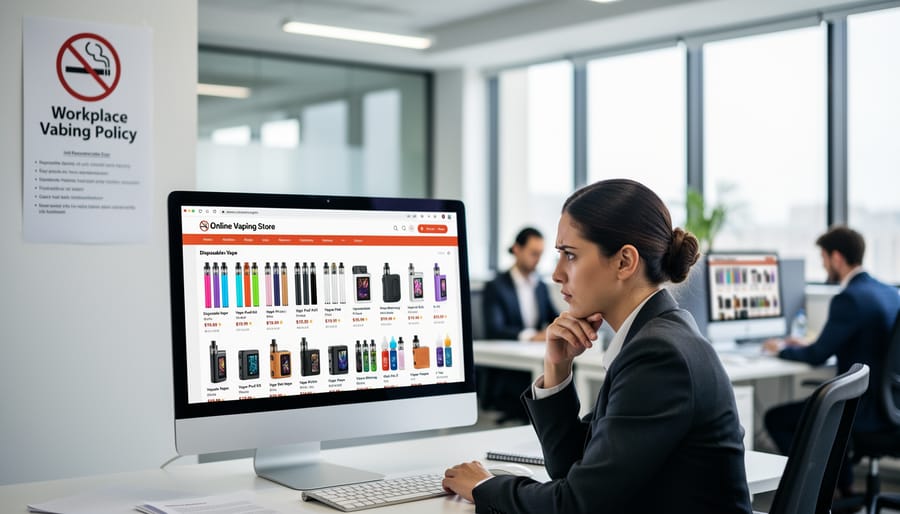
Vaping in the workplace has become increasingly common, creating new policy challenges for Canadian employers.
Federal Framework Under the Tobacco and Vaping Products Act
The Tobacco and Vaping Products Act (TVPA), which received Royal Assent in 2018, establishes the primary federal regulatory framework governing vaping products across Canada. This legislation replaced the previous Tobacco Act and introduced comprehensive controls over the manufacture, sale, labeling, and promotion of vaping products, including e-juice and vaping devices.
Under the TVPA, Health Canada regulates vaping product standards, including maximum nicotine concentrations, permitted ingredients, and child-resistant packaging requirements. The Act prohibits the promotion of vaping products in ways that could appeal to young persons and restricts advertising to locations and publications where minors are prohibited. Manufacturing standards require all vaping products to meet specific safety and quality requirements before entering the Canadian market.
From a workplace perspective, the TVPA does not directly regulate where individuals may vape. However, it establishes the foundation for understanding what constitutes a legal vaping product in Canada. Employers should recognize that the federal framework focuses primarily on product safety and youth protection rather than usage restrictions in specific settings.
The Act empowers Health Canada to monitor vaping product ingredients and requires manufacturers to report product information, including formulations and sales data. This regulatory oversight ensures that vaping products available through legal channels, whether purchased in-store or online, meet minimum safety standards. However, the ease of online purchasing raises enforcement challenges, as products from international sources may not comply with Canadian regulations.
For employers developing workplace policies, understanding the TVPA provides essential context for distinguishing between legally compliant vaping products and potentially unsafe alternatives that employees might obtain through unregulated online marketplaces.
Provincial Variations: What Changes Across Borders
While Canada’s federal Non-Smokers’ Health Act establishes baseline protections, provinces have enacted their own smoke-free legislation that significantly impacts workplace vaping policies. Understanding these provincial variations is essential for multi-jurisdictional employers and those operating in specific regions.
Ontario’s Smoke-Free Ontario Act, 2017 treats vaping products identically to tobacco, prohibiting their use in enclosed workplaces and within specified distances of building entrances. Employers must display mandatory signage and can face penalties up to $5,000 for individuals and $300,000 for corporations. Notably, Ontario’s legislation extends to THC-infused vaping products, creating additional compliance layers.
British Columbia’s Tobacco and Vapour Products Control Act similarly prohibits vaping in enclosed workplaces but provides employers with greater flexibility in designated outdoor areas. BC’s regulations emphasize employer discretion, allowing companies to implement stricter policies than provincial minimums. WorkSafeBC also requires employers to consider vaping in their occupational health and safety assessments.
Alberta’s Tobacco and Smoking Reduction Act permits vaping in certain designated areas that meet specific ventilation requirements. This provision offers employers more options for accommodation but requires careful facility planning and documentation to ensure compliance with both provincial and federal standards.
Quebec’s Tobacco Control Act takes a more restrictive approach, prohibiting vaping anywhere smoking is banned and requiring nine-meter setbacks from doorways. Quebec employers must also ensure policies are communicated in French, adding a language compliance dimension.
These provincial differences create practical challenges for national employers who must develop flexible frameworks that meet the most stringent applicable standards while maintaining consistency in enforcement and employee communication across jurisdictions.
HR professionals must navigate complex legal obligations when developing workplace vaping policies.
Employer Obligations: Where Workplace Policy Meets Compliance
Occupational Health and Safety Requirements
Canadian employers bear significant occupational health and safety responsibilities regarding workplace vaping exposure, even when employees purchase e-juice products online. Under general duty provisions found in provincial OHS legislation, employers must take all reasonable precautions to protect worker health and ensure a safe work environment. This obligation extends to addressing potential hazards from second-hand vapor exposure.
While research on long-term health effects of second-hand vapor exposure remains ongoing, employers cannot dismiss potential risks. Second-hand vapor contains ultrafine particles, volatile organic compounds, and other substances that may impact indoor air quality. Employees with respiratory conditions, chemical sensitivities, or pregnancy-related concerns may be particularly vulnerable. The duty of care requires employers to assess these risks and implement appropriate controls, regardless of whether employees use commercially purchased or online-sourced vaping products.
Indoor air quality standards provide practical benchmarks for employers developing vaping policies. Provincial OHS regulations typically require adequate ventilation and air quality maintenance in enclosed workspaces. Employers should consider conducting air quality assessments in areas where vaping occurs and ensure HVAC systems adequately manage airborne contaminants.
The precautionary principle applies when scientific evidence remains inconclusive. Given uncertainty about second-hand vapor health impacts, prudent employers treat vaping similarly to smoking by restricting it to designated outdoor areas or prohibiting it entirely on company premises. This approach demonstrates due diligence and minimizes potential liability while respecting the broad spectrum of nicotine concentrations and flavor additives available through online e-juice retailers.
Accommodation Considerations for Nicotine Dependency
Under Canadian human rights legislation, employers may face accommodation requests from employees with nicotine dependency. While controversial, addiction to nicotine can potentially qualify as a disability requiring accommodation under provincial and federal human rights codes, particularly when medically documented as a substance use disorder.
When evaluating accommodation requests related to vaping, employers must conduct individualized assessments. This includes obtaining medical documentation substantiating the dependency, understanding treatment plans, and determining whether vaping serves a legitimate therapeutic purpose in managing withdrawal symptoms. However, accommodation does not necessarily mean permitting vaping in the workplace or allowing unlimited breaks.
Employers should apply the same rigorous analysis used for other accommodation requests, balancing the duty to accommodate with operational requirements and health and safety obligations. Reasonable alternatives might include nicotine replacement therapy programs, designated break times aligned with workplace impairment policies, or referrals to employee assistance programs for cessation support.
Documentation is critical. Maintain confidential records of accommodation requests, medical evidence provided, interactive discussions held, and rationales for accommodation decisions. Employers should avoid blanket denials but recognize that undue hardship—such as compromising workplace safety or violating smoke-free legislation—may limit accommodation options. Legal counsel should be consulted when navigating these complex intersections of human rights obligations and workplace policy enforcement.
Liability Risks Employers Face
Employers who fail to implement comprehensive vaping policies face significant legal exposure across multiple fronts. Negligence claims represent a primary concern when workplace exposure to secondhand vapour causes adverse health effects in employees. Courts may find employers liable if they knew or ought to have known about the risks but failed to take reasonable preventative measures. This duty of care extends to protecting workers from hazardous substances, including e-cigarette aerosols containing nicotine and other potentially harmful chemicals.
Human rights complaints pose another substantial risk area. Employers must balance their right to maintain a safe workplace with obligations to accommodate employees who use vaping products for smoking cessation or nicotine dependency. Inadequate policies that fail to address accommodation requests properly can trigger complaints under provincial human rights legislation. The financial consequences can be severe, including compensatory damages, legal fees, and reputational harm.
Workers’ compensation claims may also arise when employees develop respiratory conditions or experience allergic reactions attributed to workplace vaping exposure. Occupational health and safety violations carry administrative penalties and potential prosecution in serious cases. Given the evolving understanding of vaping-related health impacts and the accessibility of diverse e-juice products through online channels, employers cannot afford to treat vaping policies as an afterthought or simply extend existing smoking policies without proper consideration.
The Online E-Juice Factor: New Challenges for HR
Why Online Purchasing Complicates Workplace Control
The proliferation of online vaping retailers has fundamentally altered the landscape of workplace policy enforcement. Unlike traditional retail environments where product selection remains relatively limited and localized, employees now have unfettered access to thousands of e-juice varieties through domestic and international e-commerce platforms. This accessibility extends beyond nicotine-based products to include cannabis-derived formulations, synthetic cannabinoids, and other substances that may not be readily identifiable through visual inspection alone.
The diversity of available products presents significant challenges for employers attempting to maintain safe and compliant workplaces. E-liquids containing THC, CBD, or other psychoactive substances are often indistinguishable from conventional nicotine products in both appearance and vapor production. Employers cannot reasonably determine what substance an employee is consuming simply by observing vaping behavior, creating a substantial gap in workplace oversight capabilities.
This visibility problem is compounded by the discreet nature of modern vaping devices, many of which resemble everyday items like USB drives or writing instruments. Employees can easily conceal both the devices and their usage, making policy enforcement considerably more difficult than with traditional smoking products. The odorless or minimally scented vapor produced by many e-liquids further reduces detectability.
For HR professionals and business owners, this reality necessitates policy frameworks that address not merely the act of vaping itself, but the broader implications of substance use that vaping may facilitate. Clear definitions, comprehensive education programs, and robust enforcement mechanisms become essential components of effective workplace vaping policies in this environment.
THC-Infused Products and Impairment Concerns
The widespread availability of THC-infused vaping products through online retailers presents distinct challenges for Canadian employers navigating workplace safety and impairment concerns. Unlike nicotine-based vaping products, THCa vape cartridges and other cannabis vaping devices carry potential impairment risks that directly impact workplace safety obligations.
Employers must recognize that while recreational cannabis is legal in Canada, workplace impairment remains prohibited under occupational health and safety legislation. The discreet nature of vaping devices makes detecting cannabis use more challenging compared to traditional smoking methods, as vapor dissipates quickly and may produce minimal odour. This creates enforcement difficulties for supervisors attempting to maintain safe work environments.
Canadian employers should integrate cannabis vaping products into comprehensive cannabis workplace policies that address both consumption and impairment. These policies must clearly distinguish between nicotine vaping, which typically raises health and nuisance concerns, and THC vaping, which triggers safety-sensitive position restrictions and fit-for-duty requirements.
Expert practitioners recommend implementing objective impairment assessment protocols rather than relying solely on detection methods. Training supervisors to recognize signs of impairment, establishing clear reporting mechanisms, and outlining consequences for policy violations are essential components. Employers should also clarify that while employees may legally purchase cannabis products online, bringing these items to work or consuming them during work hours or breaks violates workplace safety standards, particularly in safety-sensitive positions where impairment poses significant risks to workers and the public.
Crafting an Effective Workplace Vaping Policy
Essential Policy Components
A comprehensive vaping policy must address several critical elements to effectively manage workplace vaping while ensuring legal compliance and employee safety. Start by clearly defining what constitutes vaping devices and e-liquids, including e-cigarettes, vape pens, pod systems, and all e-juice products regardless of purchase method—whether obtained in-store or through online retailers.
Designate specific vaping areas that comply with provincial smoke-free legislation. In most Canadian jurisdictions, vaping is prohibited in the same locations as traditional smoking. Clearly identify where vaping is permitted, typically in outdoor areas away from building entrances, air intake vents, and common pathways. Specify minimum distances from doorways and windows to prevent secondhand vapour exposure.
Include provisions addressing the storage and use of e-juice products on company property. Given the accessibility of concentrated nicotine solutions through online channels, policies should restrict the handling or refilling of devices in work areas to minimize spill risks and exposure to hazardous substances.
Establish clear enforcement mechanisms and progressive discipline procedures for policy violations. Outline consequences ranging from verbal warnings to termination for repeated infractions, ensuring consistency with existing workplace policies.
Address accommodation requirements for employees using vaping products as smoking cessation aids under disability or human rights legislation. Define the process for requesting accommodations while maintaining workplace safety standards.
Finally, incorporate product safety guidelines, including proper disposal of vaping devices and e-liquids, and prohibit the use of cannabis-containing vaping products during work hours or on company premises, aligning with impairment policies and federal cannabis legislation.
Enforcement Strategies That Work
Successful enforcement of workplace vaping policies requires a structured, consistent approach that balances employee rights with business needs. Organizations should adopt progressive discipline frameworks that clearly outline consequences for policy violations while allowing employees opportunities to correct their behavior.
The progressive discipline model typically begins with verbal warnings for first-time offenses, followed by written warnings that document the specific policy violation, date, time, and location of the incident. Subsequent infractions should escalate to formal disciplinary meetings, suspension, and ultimately termination for repeated non-compliance. This graduated approach demonstrates fairness and reduces the risk of wrongful dismissal claims.
Documentation is critical to effective enforcement. Employers should maintain detailed records of all policy violations, including witness statements, photographs if applicable, and written acknowledgments from employees. This documentation proves essential if disputes arise or termination becomes necessary.
Training managers and supervisors on consistent policy application prevents selective enforcement claims. All supervisory staff should understand the policy details, recognize violations, and follow standardized procedures when addressing infractions.
Regular policy reminders through staff meetings, email communications, and visible signage reinforce expectations and demonstrate organizational commitment to enforcement. Consider periodic policy reviews to ensure rules remain relevant as vaping products and workplace norms evolve.
Employers should also establish clear reporting mechanisms that allow employees to confidentially report violations without fear of retaliation, creating accountability while maintaining workplace harmony.
Communication and Employee Education
Successful policy implementation hinges on clear, consistent communication delivered through multiple channels. Begin by distributing written policies via email and employee handbooks, supplemented by in-person or virtual information sessions that allow for questions and clarification. HR professionals should prepare talking points that explain the rationale behind vaping restrictions, emphasizing health and safety considerations rather than punitive measures.
Address common objections proactively. When employees argue that vaping is a personal choice, explain how workplace policies balance individual freedoms with collective health interests and legal compliance obligations. For those claiming vaping aids smoking cessation, acknowledge this perspective while directing them to designated areas and employee assistance programs that support wellness goals.
Ensure supervisors and managers receive specialized training to enforce policies consistently and handle violations appropriately. Create FAQ documents addressing specific scenarios, such as e-juice storage in personal lockers or vaping during breaks. Consider establishing a transition period for existing vapers, demonstrating organizational flexibility while maintaining firm policy boundaries.
Regular reinforcement through periodic reminders, policy refreshers, and integration into onboarding processes ensures sustained compliance. Document all communication efforts to demonstrate good faith implementation should disputes arise. Expert practitioners recommend annual policy reviews that incorporate employee feedback, creating opportunities to refine approaches while maintaining core protective measures.
Case Law and Precedent: Learning from Legal Challenges
Key Arbitration Decisions
Canadian arbitration decisions regarding workplace vaping policies remain limited but are gradually establishing precedent. Early cases have largely upheld employer authority to implement comprehensive vaping restrictions, particularly when policies are clearly communicated and consistently enforced.
Arbitrators have generally recognized employers’ legitimate interests in maintaining workplace health and safety, preventing customer complaints, and protecting non-users from exposure. Several decisions confirm that employers can discipline employees for violating vaping policies, provided the rules are reasonable and employees received adequate notice. Progressive discipline principles apply, meaning first-time offenders typically receive warnings rather than termination unless the violation is particularly egregious.
Key factors influencing arbitration outcomes include whether the policy clearly defined prohibited areas, whether the employer provided designated vaping locations, and whether management applied rules consistently across all employee groups. Arbitrators have been less sympathetic to grievances where employees violated explicit policies or vaped in sensitive areas like customer service zones or confined spaces.
Expert insight suggests employers strengthen their position in potential grievances by documenting policy communication, maintaining clear evidence of violations, and demonstrating even-handed enforcement. Consulting with legal counsel before implementing disciplinary measures for vaping violations helps ensure defensibility if challenged through the grievance process.
Human Rights Complaints and Outcomes
Human rights complaints related to workplace vaping typically involve accommodation requests for nicotine addiction or underlying medical conditions. While Canadian human rights tribunals have addressed smoking accommodations, vaping cases remain relatively limited in reported decisions.
Employers must assess accommodation requests on an individual basis, considering whether nicotine dependency constitutes a disability requiring accommodation under human rights legislation. The duty to accommodate extends to the point of undue hardship, which requires employers to demonstrate genuine operational or financial constraints.
Tribunal decisions have emphasized that accommodation does not mean unrestricted workplace access. Employers can maintain health and safety standards while exploring reasonable alternatives, such as designated areas or modified break schedules. The ease of obtaining e-juice online does not strengthen accommodation claims, as accessibility relates to personal consumption rather than workplace rights.
When evaluating complaints, adjudicators examine whether employers engaged in meaningful dialogue, considered medical documentation, and explored available options before denying requests. Documentation proving genuine effort to accommodate while maintaining workplace safety standards provides essential protection against successful claims. HR professionals should maintain detailed records of accommodation discussions and implement consistent assessment processes for all requests.
As the landscape of vaping products continues to evolve with expanding online marketplaces and innovative delivery systems, Canadian employers must remain vigilant in their approach to workplace vaping policies. The ease of purchasing e-juice online, often with limited transparency regarding nicotine content or ingredients, creates ongoing challenges for maintaining safe and compliant work environments.
HR professionals should recognize that effective vaping policies require more than initial implementation—they demand regular review and updates to reflect changing product availability, emerging health research, and evolving legal standards. A comprehensive policy framework must balance legitimate employee rights with workplace safety obligations, clearly articulating where, when, and under what circumstances vaping is permitted.
The expert consensus emphasizes that successful policy management combines three critical elements: clear written policies aligned with applicable provincial legislation, consistent enforcement mechanisms, and ongoing communication with employees about policy rationale and health implications. Given the complexity of navigating multiple jurisdictions and the intersection of occupational health and safety law, employment standards, and human rights considerations, employers benefit significantly from professional guidance.
We strongly recommend conducting an immediate audit of your current workplace policies to identify gaps related to vaping and e-cigarette use. Consider consulting with employment law specialists to ensure your policies meet current legal requirements while addressing the unique challenges posed by easily accessible online e-juice products. Proactive policy development today prevents costly compliance issues and workplace disputes tomorrow, positioning your organization as a responsible employer committed to employee wellbeing and regulatory excellence.